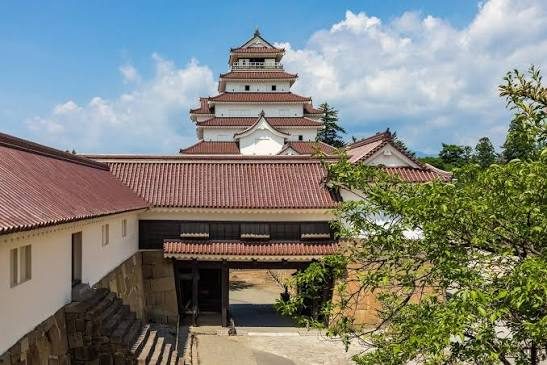
The only red-tiled keep in JapanThe only red-tiled keep in Japan
Today Tsurugajo's roof is covered in vivid red tiles — the only example among all of Japan's surviving or reconstructed castle keeps. Many visitors find themselves wondering: why is Aizu's castle the only red one?
The answer lies in the climate of snow countryThe answer lies in the climate of snow country
Ordinary roof tiles are "ibushi" tiles — gray to black, finished with a thin carbon film on the surface. But tiles made this way absorb water easily, and in a cold region like Aizu, that absorbed moisture would freeze and expand in winter, cracking the tiles — a weakness known as frost damage.
The solution adopted was "red tile": tile glazed with an iron-rich coating and fired at high temperature. The glaze coats the tile's surface in a glass-like layer that keeps out water and resists frost damage. In other words, the red tiles weren't chosen for looks — they were a practical technology for surviving Aizu's harsh winters.
When did it turn red?When did it turn red?
Records suggest Tsurugajo was re-roofed with red tile in the mid-Edo period, around the Kanpo era (early 18th century). Before that, it's believed to have used ordinary ibushi tile like other castles. The present keep was rebuilt in 1965, and its reconstruction followed this red-tile tradition, with periodic re-roofing continuing since the Heisei era.
A contradiction with the name "white castle"?A contradiction with the name "white castle"?
Tsurugajo is often introduced as a "white castle," a phrase referring to its white plaster walls, which is no contradiction at all with its red roof tiles. If anything, it's precisely the contrast between white walls and red tiles that gives Tsurugajo a look distinct from every other surviving or reconstructed keep in Japan — a landscape unique to Aizu.