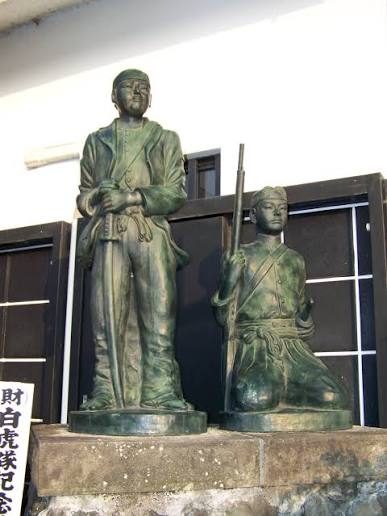
The Byakkotai was never a single unitThe Byakkotai was never a single unit
Facing the Boshin War, the Aizu domain organized its samurai by age into the Genbutai (50 and older), Suzakutai (18–35), Seiryutai (36–49), and Byakkotai (16–17). Below even that was a "junior corps" of boys aged 14–15. In other words, the Byakkotai wasn't even the youngest unit — it was simply one part of the domain's all-out mobilization. Enrollment was voluntary, and some boys are said to have lied about their age to join.
Rout at Tonoguchihara, then Mount IimoriRout at Tonoguchihara, then Mount Iimori
In August 1868, roughly 340 Byakkotai soldiers, including the Shichū Second Unit, were sent into battle but were overwhelmed and routed by imperial forces at the Battle of Tonoguchihara. The boys of the Second Unit made their way through a tunnel along the Tonoguchi irrigation channel to Mount Iimori — but only about twenty of them reached it.
The castle was not, in fact, burningThe castle was not, in fact, burning
Looking down from Mount Iimori, what the boys saw was black smoke rising from burning samurai residences in the castle town. Tsurugajo Castle itself had not fallen at this point. But amid exhaustion and confusion, the accepted account holds that the boys misjudged the source of the flames and concluded, mistakenly, that the castle had already fallen. Sixteen drew their blades — some taking their own lives, others assisting one another — and died. Together with three who died nearby afterward, nineteen graves now stand on Mount Iimori.
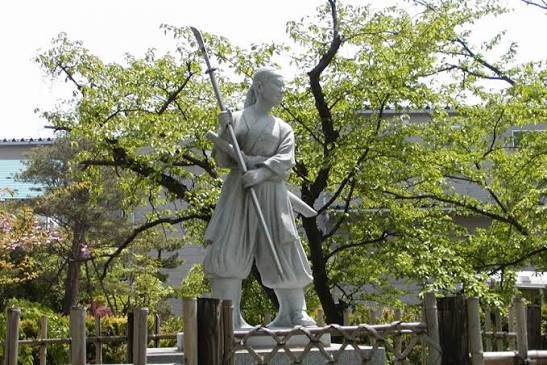
Of the sixteen, only one was revived: Iinuma Sadakichi. Rescued by a local woman, Indei Hatsu, he later changed his name to Sadao and devoted his life to building communications infrastructure as an engineer for the Ministry of Communications. He kept his silence for decades, and only began speaking about the Byakkotai late in life — carrying the weight of being "the only one who survived" for more than sixty years.
Was Choshu really the "chief villain" behind Aizu's ordeal?Was Choshu really the "chief villain" behind Aizu's ordeal?
The hard-line push to brand Aizu an "enemy of the court" and pursue it relentlessly was less the will of Choshu alone than a political line the new government as a whole — centered on the Satsuma–Choshu alliance — needed to draw in order to hold its authority together. Because troops from Choshu happened to stand at the front lines of the fighting, later generations settled on the simplified image of "Choshu, the chief villain who bullied Aizu" — but that is only half the story.
Among the young Choshu samurai who actually stood on that battlefield, quite a few went on, after the war, to quietly support talented people from Aizu. Okudaira Kensuke sheltered Yamakawa Kenjiro, a defeated Aizu samurai, in his own home and gave him an education — the first step on Yamakawa's path to becoming president of Tokyo Imperial University. Maehara Issei was another Choshu man known for his understanding toward reconciliation with Aizu.
One can argue that the severity of the Meiji government's treatment of Aizu had more to do with a political line drawn by the victorious Satsuma–Choshu coalition to prove its own legitimacy, than with Choshu's own wishes. Choshu, too, may simply have been assigned the role of "villain" within that larger political machinery.