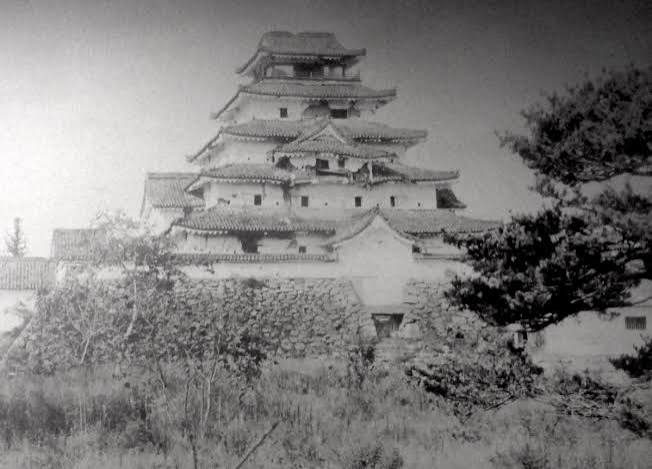
600 years ago, this land was called "Kurokawa"600 years ago, this land was called "Kurokawa"
Aizu's center had been a town called Kurokawa, ruled by the Ashina clan since the Kamakura period. In 1589 Date Masamune destroyed the Ashina and took the region, only to be forced out again barely a year later after drawing the displeasure of Toyotomi Hideyoshi. In his place came one of Hideyoshi's most capable retainers, a general equally skilled in the arts of war and governance: Gamo Ujisato.
Renamed "Wakamatsu," and a seven-story black keepRenamed "Wakamatsu," and a seven-story black keep
Ujisato was granted the vast domain of 920,000 koku and renamed the town from "Kurokawa" to "Wakamatsu." Accounts differ — some say it echoes "Wakamatsu no Mori," a grove near his birthplace of Hino in Omi; others say it was meant to invoke the prosperity of the Gamo clan. At the same time he built a magnificent castle with a seven-story keep.
The keep Ujisato built was not the white structure we see today. It is believed to have been a "black castle" — lacquered in glossy black with gold-leaf accents, echoing the style of Osaka Castle and projecting the authority of the Toyotomi regime. The castle only took on its present white form after later renovations under the Kato clan.
The surprising origin of the name "Tsurugajo"The surprising origin of the name "Tsurugajo"
Hearing "Tsurugajo" — literally "Crane Castle" — most people imagine the elegant white walls likened to a crane's plumage. But that isn't what history records. The accepted view is that "tsuru" (crane) comes from the Gamo family crest, the "facing cranes" (mukai-zuru). The association with white walls is a beautiful misunderstanding born later.
A tale that "the castle was built where a white crane descended" is told in some circles, but there is no documentary evidence for it — the family-crest explanation is far better supported. The prettier the story, the more worth separating fact from legend.
The town plan lives on todayThe town plan lives on today
The skeleton of the castle town Ujisato laid out — a moated inner district (kakunai) for the samurai class, surrounded by an outer district (kakugai) for townspeople — still shapes the streets of Aizuwakamatsu even after modern development since the Meiji era. Walk down Nanukamachi Street or Omachi Street and you're tracing an urban plan laid down more than 400 years ago, one still lived on today.