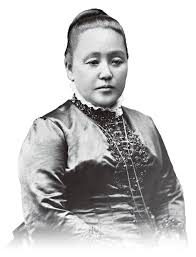
A woman who embodied "what must not be done"A woman who embodied "what must not be done"
Yamamoto Yae (later Niijima Yae) was born into a family of Aizu gunnery instructors and grew up handling firearms from an early age. During the Aizu War she is said to have taken up a state-of-the-art Spencer rifle and fought, dressed as a man, during the siege of Tsurugajo. Her bravery later earned her the nickname "the Joan of Arc of the Bakumatsu."
After the war, to KyotoAfter the war, to Kyoto
The defeated Aizu domain was branded an "enemy of the court," and many samurai and their families fell into hardship. After a difficult period, Yae too relocated to Kyoto, relying on her brother, Yamamoto Kakuma. There she met Niijima Jo, who would go on to found Doshisha English School (now Doshisha University). Yae married Jo and devoted herself to advancing women's education and to the Japanese Red Cross, serving as a volunteer nurse during the Russo-Japanese War.
What became of the "rebels'" daughtersWhat became of the "rebels'" daughters
Yae was far from the only Aizu woman to forge a new path in the years after the war. Oyama Sutematsu, daughter of an Aizu samurai, traveled to the United States as one of Japan's first female overseas students, and later, as the wife of Army Minister Oyama Iwao, became a leading figure in the social diplomacy of the Rokumeikan era. That daughters of families once branded "enemies of the court" would go on to stand at the forefront of education and diplomacy in the new Meiji era is another story of Aizu's underlying resilience.
Ironically, Oyama Sutematsu's husband, Oyama Iwao, had been one of the imperial commanders during the Aizu War. This marriage, uniting a former "enemy's" daughter with her one-time adversary, is said to have made no small stir in the society of the time.