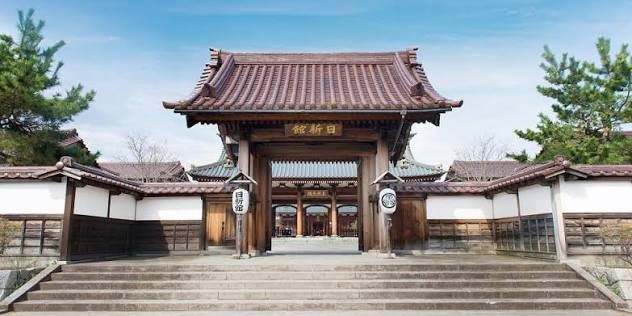
Every samurai child went to NisshinkanEvery samurai child went to Nisshinkan
Opened in 1803, Nisshinkan, the Aizu domain school, enrolled every samurai boy at age ten under a universal-admission policy. Among roughly 300 domain schools nationwide at the time, this level of comprehensive schooling was unusual. The grounds even held what is said to be Japan's oldest swimming pool and an observatory for astronomy — a full-spectrum institution spanning far beyond the literary and martial arts into the sciences.
The Rules of the Jū — a second school before age tenThe Rules of the Jū — a second school before age ten
Children aged six to nine, not yet old enough for Nisshinkan, were organized by neighborhood into groups of about ten called "jū." These were not adult-run organizations but self-governing bodies in which the oldest child served as "jūchō" and guided the younger ones. Every day the group recited a set of seven prohibitions known as the "Rules of the Jū."
The rules' final line — "what must not be done, must not be done" — sounds at first like an unexplained repetition. But pedagogically, it's thought to have been a deliberate design: rather than endlessly explaining the reasons behind right and wrong to small children, it aimed to instill, as a felt sense, that certain lines simply must not be crossed. Impressing the sense of a rule before the reasoning behind it — a technique that still has something to say to modern early-childhood education.
What the rules forbade — the weight of "never bully the weak"What the rules forbade — the weight of "never bully the weak"
The Rules of the Jū forbade disrespect toward elders, lying, cowardly conduct, bullying the weak, and even eating or drinking outdoors or chatting alone with women. Some items feel restrictive by modern standards, but what runs through all of them is a single consistent value: cowardice is never excused. That value would go on to shape the conduct of the Byakkotai boys directly.
Torn down, rebuilt 10km awayTorn down, rebuilt 10km away
Nisshinkan's buildings were burned and demolished in the Boshin War, but in 1987 they were faithfully reconstructed about 10km from the original site, following the original design and scale. It is now open as a museum, where detailed dioramas let visitors trace what a day in the life of a samurai child there was actually like.